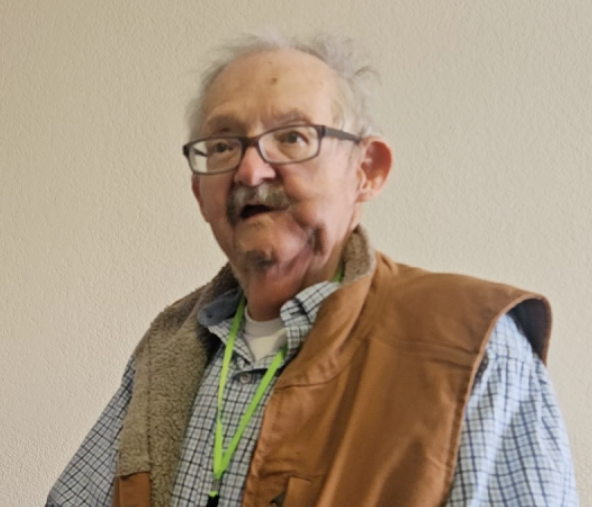
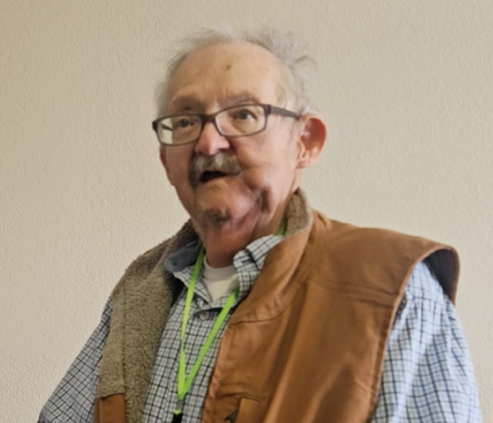
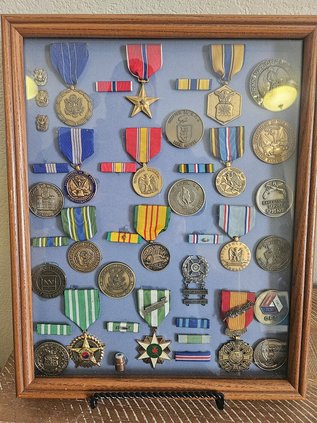
PITTSBURG, Kan. — Born and raised in western Pennsylvania, Rick Fulton admits he wasn’t a stellar student. Raised in a single-parent home, he is a self-professed “street kid” whose chances of getting through high school were pretty slim.
But in 1962, Rick did graduate at the age of 17 and “As soon as I had that piece of paper in hand, I was gone.”
Rick said he tried the Army and the Navy — never once considered the Marines — and looked at the U.S. Air Force. Underweight and burdened with thick glasses, Rick said he caught an Air Force recruiter having a hard time making his monthly quota and enlisted. He received his basic and advanced training at Lackland Air Force Base in San Antonio, Texas.
At Lackland, Rick was first assigned to be a draftsman, but when the course cancelled, he was reassigned as an AP (Air Police), the Air Force equivalent to the Army’s MP. While in AP school, Rick and his classmates were sent to Florida during the Cuban Missile Crisis. Their training suspended, they acted as provisionary APs during the military build-up for the possible invasion of Cuba.
Still 17 at the time, someone realized he was carrying a firearm and decided to post him along a desolate road that connected two bases, minimizing his contact with the rest of the outside world.
When the crisis passed, Rick and his classmates returned to Texas to finish their training. Having grown up on the streets, Rick said the thought of being a cop didn’t have any positive connotations, but he ended up enjoying the career and is still a member of the Air Force Security Forces Association at the age of 81.
His first duty station, Rick was on a World War II German airbase outside of Tripoli, Libya, where a trusted non-commissioned officer (NCO) recommended him as a dog-handler. In Libya, Rick was primarily assigned to protect an ammunition storage area of about five square miles, supporting U.N. operations in the Congo at the time.
After 18 months in Libya, Rick was transferred stateside to the Strategic Air Command (SAC) base in Arkansas. There, he encountered the rampant racism common in the 1960s South.
“The first 30 minutes I was there,” Rick recalls, “I heard the N-word more than 100 times. And they didn’t like Yankees — I’m from Pennsylvania.”
Rick said he just kept his mouth shut, which was particularly hard for him, and did his job. As his enlistment was coming to an end, he did not want to stay in SAC due to the toxic racist environment. Contemplating getting out, he was offered a change of occupational specialty.
Taking advantage of a SAC program, Rick switched his specialty and was promoted to E-4 (Senior Airman). He wanted to be a combat photographer, but no slots were open, so he opted for public affairs, a job that Rick really took to.
Although he volunteered for service in Vietnam, Rick was instead sent to Korea where his commanding officer tried to put him on patrol as an AP dog handler again. He complied for a few weeks before going back to public affairs. During his time in Korea, the “second” Korean war flared up in 1966 with cross-border raids and firefights, and Rick was assigned to cover it for the news.
In 1967, after volunteering again, Rick received orders to Tan Son Nhut Air Force Base in Saigon, Republic of Vietnam (RVN), where he received another promotion to Staff Sergeant (E-5), making him an NCO.
Rick was at Ton Son Nhut when the Tet Offensive began in January 1968, and the airbase came under heavy attack by communist ground forces. Dodging enemy mortar and machine gun fire, Rick and his compatriots rallied at their headquarters and prepared to defend the base.
Rick, being the only one trained to use weapons as an AP, was, of course, told to stay in the office and man the telephone. Doing as he was told, Rick did exactly that. Taking cover under a desk, Rick spent his time relaying telephone messages between his commanding officer, who was trapped in town, and generals from all over Vietnam and even from Hawaii and the Pentagon wanting to know what was going on in Saigon.
“Trapped under a desk working the telephone during Tet. That’s my big war story,” Rick joked.
His shop lost two men in the fighting.
All over Vietnam, public affairs personnel had been killed or wounded during the Tet Offensive. To fill the gaps men were taken from the headquarters in Saigon and scattered around the country. Rick was ordered to the I Corps sector along the DMZ to submit reports for the news. Over the next 59 days, Rick reported from places that would become iconic touchstones of Marine Corps history such as Da Nang, Hue, Dong Ha, and he even spent the night at Khe Sahn, reporting on air operations supporting the besieged firebase.
“That was an interesting experience,” Rick recalls, “but the Marines took care of us.”
After Tet, Rick remained in Vietnam, covering different assignments until the end of his enlistment in 1969.
During his time in the service, Rick was always wanting to learn. He observed, asked questions, and absorbed all the knowledge he could about whatever subject, whether it was part of his job or not. With such a thirst for knowledge, Rick set his sights on college, but with poor grades from high school, things didn’t look promising.
Until he spoke to his uncle who lived in Seneca, Missouri, who suggested he attend Pittsburg State, at the time known as the Kansas State College of Pittsburg. Unsure of his chances of admittance, his uncle reassured him that “Pittsburg will take anybody.”
Rick enrolled in the fall semester of 1969. Early in his college career, Rick joined the college Skydiving Club, where he met an attractive young lady, and literally fell in love.
“She had seven jumps. I only had two,” Rick said.
Rick worked his way through college, including at The Morning Sun. His time as a local reporter was limited as he didn’t conform to the way things were done.
“There’s three ways to do things,” Rick said, “the right way, the wrong way, and the military way. I did things the military way. Nothing they did was up to Air Force standards.”
Eventually, Rick put his AP training to good use and secured a job with the campus police as a dispatcher. While attending graduate school, he was moved up to patrolman and made the Dean’s List, to boot.
Rick enlisted in the Kansas National Guard while in college and was assigned to the local Pittsburg unit, at the time, Company A of the 3rd Battalion, 137th Infantry Regiment. The unit was not very well received in the community in those years.
In the Guard, Rick served as a basic rifleman under the command of George Primm, who had served as an adviser to the South Vietnamese Army. He emphasized small unit tactics, pitting his soldiers against each other in force-on-force training exercises.
“George turned that unit from a penny-pinching timewaster into a very highly thought-of light infantry company,” Rick recalled. “I was one of his staff sergeants. He believed in muddy boots and a clean weapon and taught us what he learned in Vietnam.”
Rick’s time in the infantry would prove to be of great value in his civilian career when talking with generals, as he spoke their language.
After graduating with a master’s degree in 1976, Rick was offered a job at Fort Leavenworth doing what he had done in the Air Force, but this time as a civilian contractor in the Army’s Public Affairs Office. From Leavenworth, he went to Fort Hood, Texas, to edit the base newspaper where he was recommended by the base commander to another general in Korea.
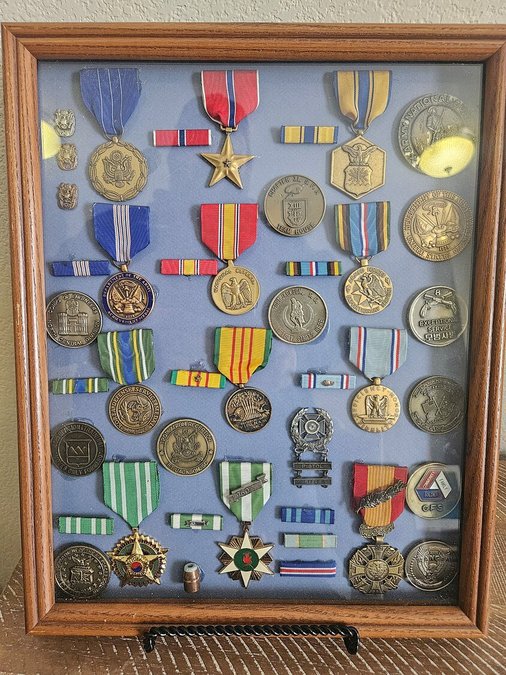
In 1982, Rick and his family moved to South Korea for two years where he worked as a speechwriter, gaining a respectable reputation. After two years, Rick returned to the States briefly before being called back to Korea in 1986 for an extended tour. For his efforts, he was awarded the Meritorious Civilian Service Award, the civilian equivalent of the Legion of Merit.
“It was like deja vu all over again,” Rick said.
Returning to the States after the 1988 Olympics, Rick went to work with the Corps of Engineers in Chicago, then to Fort Jackson, South Carolina.
Rick retired due to downsizing after more than 30 years of service.
“Military service saved my life,” Rick concluded. “I’m not kidding when I say that. I learned discipline. I learned some skills. I learned what teamwork was all about.”
As veterans, Rick said, we all march to the beat of the same drum — admittedly, a different one than civilians hear — and that can often lead to misunderstandings. But there is value in that service.
All veterans need to know that and it is important to tell your story.
This reporting is made possible, in part, by the Support Local Journalism Project Fund. Learn more at: southeastkansas.org/Localnews